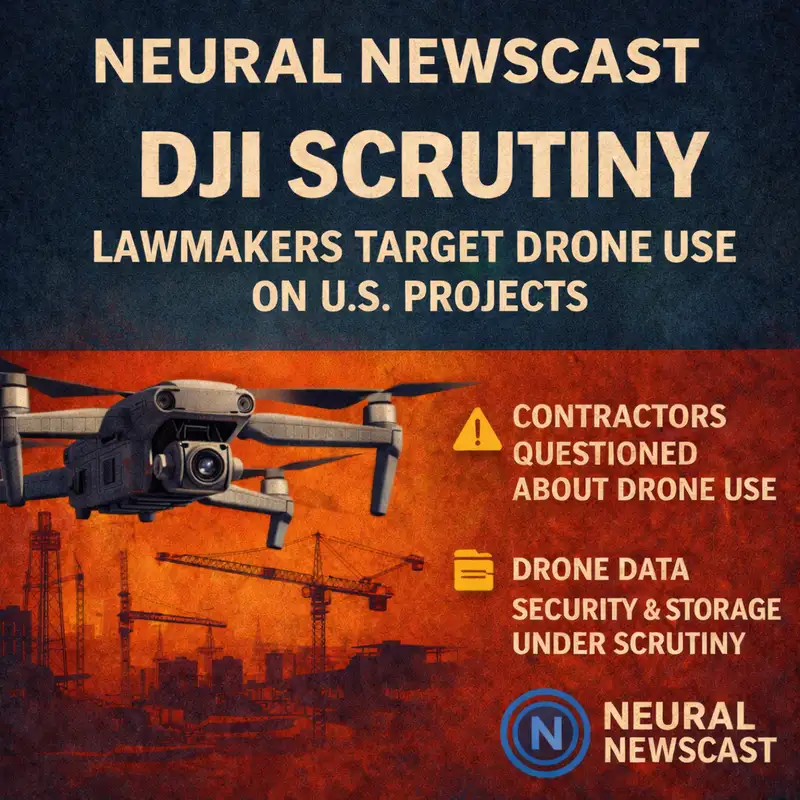
US Senators Put Federal Contractors Under the Microscope Over DJI Drone Use
Welcome to Neural Newscast. I'm Natalie Keene. And I'm Daniel Grove. Today we're tracking a pretty big shift in how Washington is policing DGI drone concerns here in the United States. For years, the DJI debate has been about policy tools like bans, warnings, executive orders, restrictions aimed at the manufacturer. Now lawmakers are getting more direct, basically calling out American companies by name and asking what they're doing with DJI drones on sensitive government work. Drone DJ reports that Senators Maggie Hassan of New Hampshire and Gary Peters of Michigan sent letters to major construction and engineering firms. The list includes Bechtel, Hansel Phelps, and Brassfield and Gory. And the concern is pretty straightforward, but high stakes. Lawmakers warn that DJI drones flown at secure locations could create pathways for sensitive data to reach the Chinese government. DJI has repeatedly denied that, and the company points to audits and security assessment sites says show no unauthorized data transmission. What makes these letters feel different is how specific they get. The senators cite named projects and point to public materials, like marketing content and social media posts, that they believe show DJI use continuing even after years of federal warnings. Yeah, and they're not asking for broad assurances here. They want a granular accounting. Contractors are being asked to list every drone and drone component they own, lease or operate, including the make, model, and when each one was first put into service. They also want contract-by-contract disclosures, showing where drones were flown on projects tied to the Department of Defense, Homeland Security, intelligence work, or nuclear-related sites, even if drone flights weren't an official deliverable on the contract. Because modern construction drones are not just flying cameras, right? They can nap facilities capture really high-resolution imagery and document layouts and terrain in ways that could expose vulnerabilities. And at sensitive sites, even routine progress documentation can turn into a security issue. Congress is also pressing on data handling. The letters ask how drone data is stored and protected, whether those systems connect into broader company networks, and which mobile devices are used to operate drones out in the field. They're also seeking records of cybersecurity audits, internal testing, incident reports, and any waivers requested to keep Chinese-made drones in use. And they want company policies on data retention, compliance with federal acquisition rules, and how anomalies are handled. The Senators point to a January 2024 joint bulletin from CISA and the FBI that raised three broad risks with Chinese-manufactured drones, data collection and transfer, firmware updates that could introduce unknown capabilities, and network-connected systems that could expose wider data sets. That bulletin also noted these risks can exist across the drone industry, but lawmakers argue the stakes go up with Chinese companies because of laws that can require cooperation with state intelligence services. All of this is happening as broader federal scrutiny keeps tightening. DJI has faced years of escalating actions, from purchase bans in parts of government to additional restrictions through designations and acquisition rule changes. And a mandated security review could affect whether DJI devices remain legal to sell in the U.S. market. But the big shift here is enforcement. Instead of relying only on federal agencies to police compliance, senators are pushing responsibility downstream to the companies using drones on government work, with detailed documentation and accountability attached. And it makes sense why contractors are central. Construction firms were early adopters of drones, and DJI dominated that market. Wawmakers seem concerned. Lessons carved the sect. Second, which caused the lessons by the end of a capital, and set it to the places they have in future. So the stakes for contractors are real, congressional oversight, reputational risk, and potential contract consequences if they can't demonstrate compliance and strong data security practices on sensitive projects. Bottom line, the DJI debate in the U.S. isn't just about whether the drones should be restricted anymore. It's increasingly about who is still using them, where they're being flown, and whether safeguards are actually strong enough when critical infrastructure is involved. That's the update from Neural Newscast. I'm Natalie Keene. And I'm Daniel Grove. If you want more stories like this, follow the show and share this episode with a friend. Neural Newscast is AI-assisted, human-reviewed. View our AI transparency policy at neuralnewscast.com.