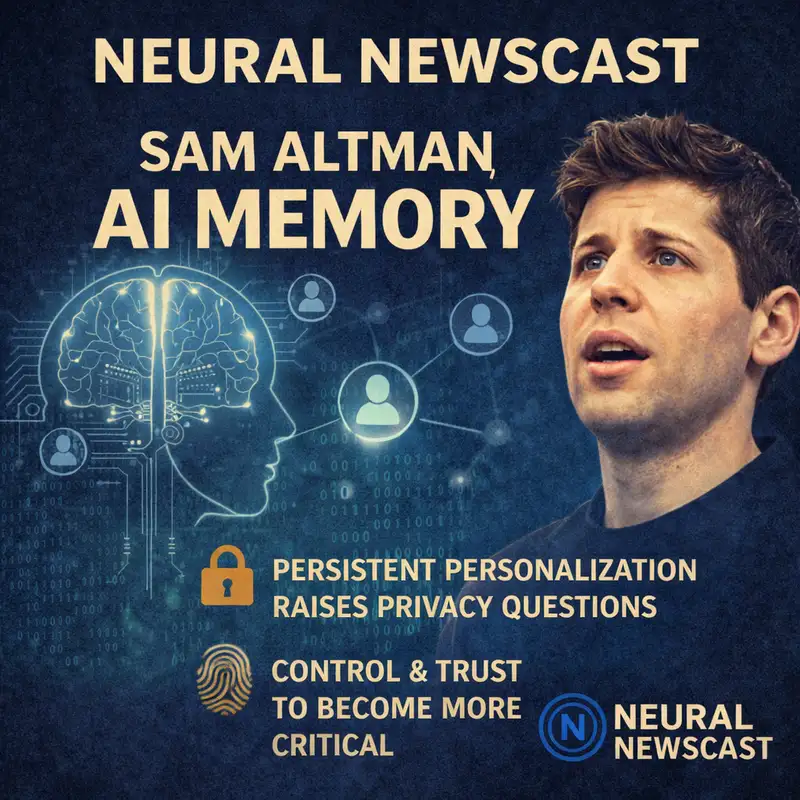
Sam Altman’s Big Bet: AI With “Infinite Memory”
Welcome to Neural Newscast. I'm Julia Fen. And I'm Marcus Shaw. Today we're looking at a pretty provocative idea from OpenAI CEO Sam Altman, that the next big leap in AI won't be smarter reasoning, but a stronger memory. Altman made the case in a conversation with journalist Alex Cantorowitz, and he pointed to what he sees as a major shift, AI systems that don't just answer questions well but actually remember you, your preferences, and your history over time. He described it as something close to infinite memory. And the idea is pretty simple on the surface. If you've told an AI what you do for work, what you're trying to learn, how you like things summarized, or what tone you prefer, you should not have to repeat it every time you start a new chat. Right. Altman's argument is that this kind of persistent memory could be the real difference maker, not because it makes the model inherently smarter in the abstract, but because it makes the tool dramatically more useful in daily life. It's also kind of a reframing of what progress looks like. For years, a lot of the public conversation has been about reasoning benchmarks, harder math problems, more complex coding tasks, and whether models can follow multi-step instructions without slipping. And Altman isn't dismissing reasoning. But he's suggesting that a system that remembers you might feel more intelligent in practice than a system that just scores higher on tests. Here's a practical example. Imagine an AI that remembers your training for certification, that you prefer quizzes over long explanations, that you've got limited time on weekdays, and that you're coming back after a two-week break. That memory changes the whole experience. Or think about work. A persistent assistant could remember how your team writes status updates, the structure of your weekly reports, the stakeholders you usually email, and the style guide you follow. It's less about one brilliant answer and more about continuity. Altman also noted a very human limitation. Even the best personal assistant can't remember every word you've ever said. But an AI system, at least in theory, can store a lot more detail and pull it back up instantly. And that's where it starts to feel both exciting and a little unsettling. Altman said AI memory is still early, but he imagines it getting better over time, potentially remembering every detail of your life, including subtle habits and preferences. Yeah, because then the obvious question is, what happens when a system knows not just what you asked today, but what you feared last year, what you regret, who you argue with, what you buy, and what you might do next? Because memory is not neutral. If it's accurate and comprehensive, it can help you. If it's wrong, it can mislead you. And if it's exposed, it can harm you. Persistent memory turns a chatbot into a long-term record of your personal life. And it forces us to ask about control. Can you see what the system remembers? Can you edit it? Can you delete it fully? And can you separate what the AI remembers for personalization from what a company might retain for security, analytics, or compliance? Altman acknowledged the privacy concerns, and he also suggested something else. As AI becomes more persistent and personalized, people may develop relationships with it, even a sense of companionship. That's a major cultural shift. If an AI remembers your story, checks in on goals you mentioned months ago, and adapts to your moods and routines, it can feel less like software and more like a presence. But companionship powered by memory comes with some hard boundaries we'll need to define, not just what the AI can do but what it should do, and how we protect people from manipulation, over-dehundance, or misplaced trust. There's also a competitive backdrop here. The article notes that OpenAI is facing stronger competition, including from Google, where its Gemini line has been exceeding expectations. That kind of pressure can accelerate product choices, including memory features. Altman reportedly declared a code read internally and redirected resources toward a new model effort, codenamed Garlic. Even if codenames come and go, the message is pretty clear. The pace is fast and the stakes are high. And memory isn't just a software feature, right? If you're storing and retrieving long-term personal context for millions of people, that touches infrastructure, security, and policy. You need safeguards, auditability, and clear user controls built in from the start. So where does that leave us? Altman's bet is that the AI people actually want is the one that remembers. The AI that feels consistent, helpful, and personalized across weeks and years, not just impressive in a single moment. And the counterweight is trust. A system with deep memory can become a powerful assistant, but only if users believe their information is protected, that they can control it, and that the system won't use it against them. A useful way to think about it is this. Reasoning determines how well an AI can think. Memory determines how well it can know you. The combination is transformative, but only if the boundaries are clear. We'll keep tracking how companies implement persistent memory, what controls they offer, and what regulators and privacy advocates demand as these systems become more embedded in everyday life. If you want more episodes like this, follow Neural Newscast and share it with someone who's thinking about what AI should remember. Neural Newscast is AI-assisted, human-reviewed. View our AI transparency policy at neuralnewscast.com.
Creators and Guests