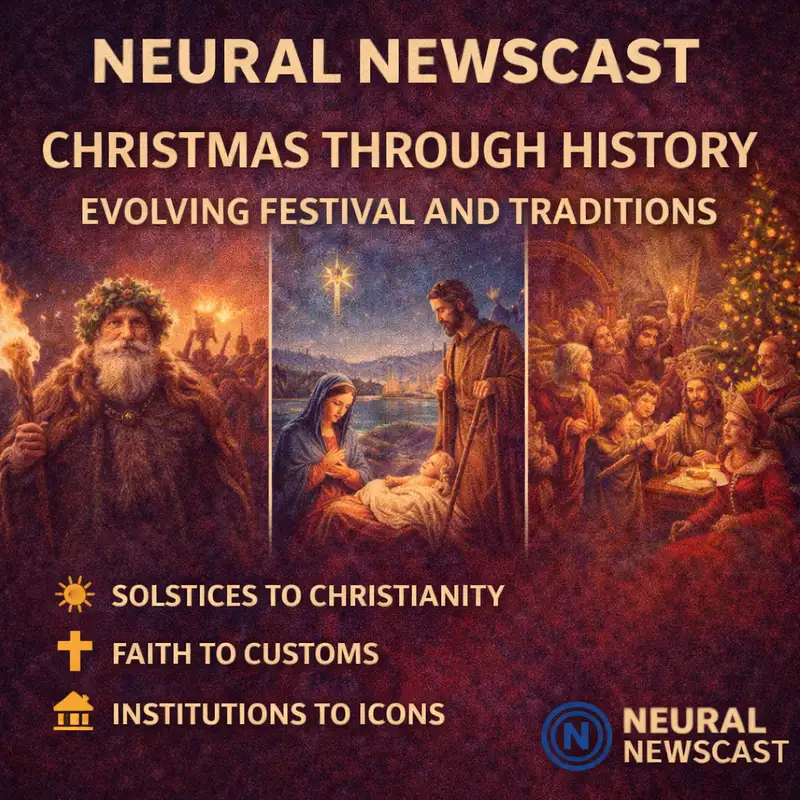
Deep Dive: Christmas - From Solstice Ritual to Global Holiday
You're listening to Neuro Newscast. I'm Hassan al-Khalil. Today, we're looking at Christmas as a historical process, not this one frozen tradition, and what its evolution tells us about society, power, and cultural memory. And I'm Oliver Grant. We're going to track a few key transitions here, right? From solstice-era rituals to early Christian decisions about the calendar, and then into medieval public customs that basically turn Christmas into a whole social season. The core idea is that Christmas works kind of like a cultural palimpsest. Each era writes new meaning over older layers without fully erasing what came before. And that helps explain why a religious feast, a family holiday, and a commercial season can all feel like, you know, the same event. Yeah, because those layers were added under different incentives. So the holiday ends up holding multiple logics at once. Theological symbolism, social cohesion, political strategy, economic exchange. And if you follow the incentives, you can usually make sense of why certain traditions just stick around. All right. We start at the winter solstice. Long before Christianity, mid-winter meant darkness, cold scarcity. And in that environment, communal festivals weren't just nice. They served a pretty practical psychological purpose. They reassured people that light returns, life persists, and the group endures. That baseline matters a lot because it helps explain why midwinter celebrations pop up across regions. When the underlying constraint is seasonal hardship, you start seeing repeated patterns, shared meals, symbolic light, rituals of renewal. Historically anchored, licensed break from normal life, in the Roman world, the big template is Saturnalia. It started on December 17th and then it expanded into a longer stretch ending around December 23rd. and it was known for this licensed break from normal life like a public declaration that for a brief time the rules loosened and saturnalia had these institutional features that made it durable public business paused schools closed courts closed you can think of it as an early form of coordinated holiday downtime, which makes mass participation easier and also reinforces the idea that everybody's in it together. The most striking feature is inversion. Masters served slaves at dinner. Social hierarchies were symbolically suspended. people wore more colorful clothing instead of the formal toga. And it was described as the best of days, evoking this mythic golden age of equality and abundance. Right, and role reversal isn't just spectacle. It can function as a safety valve. If a society is rigid, then controlled inversion is a controlled release of pressure. The system signals flexibility without actually dismantling the structure underneath. Saturnalia also seeded material traditions. Greenery like holly, ivy, fur, these show up as symbols that life continues even in dormancy. And gift-giving mattered. Romans exchanged small candles and clay figurines, little gestures that redistributed a bit of wealth and strengthened social ties. Small gifts are economically interesting because they scale. Even when resources are limited, modest exchange can still be widespread. And that broad participation is what creates a shared seasonal norm. Later, Christian practice could adopt the behavior without adopting the original theology behind it. North of the Roman world, Germanic and Norse traditions add another layer, yule. Here, the emphasis is, pretty explicitly, the contest between darkness and light. The Yule log, burned as a big oak or ash trunk, represented rekindling the sun, and was believed to bring protection and fortune. What stands out in Yule is the symbolic economy of materials. A log large enough to last is also a public display of preparation and resilience. That kind of ritual object communicates stability when uncertainty is highest. And evergreens meant more than decoration. They were treated as living proof of endurance. Missaltoe, which Celtic Druids held sacred, stayed green when other plants faded and was believed to have restorative powers. Later, those same symbols show up in Christmas settings, just with new interpretations layered on top. Once a symbol is widely recognized, it becomes reusable. Cultures can reassign meanings while keeping the familiar object. and that reuse lowers the cost of adoption, because people already get the basic emotional signal the symbol sends. Northern European folklore also contributes figures that at least resemble later Christmas characters. Odin was imagined leading the wild hunt across the winter sky, a presence that's both awe-inspiring and threatening. and the yule goat shows up as a harvest-linked symbol these don't map neatly onto modern santa but they do show how winter storytelling shaped expectations it's a good reminder that modern holiday figures are often composites Over time, multiple regional narratives merge, and what survives is what best fits shared rituals, family storytelling, and then, eventually, mass media distribution. Now, we shift to early Christianity. The early Christian community didn't initially center celebrations of Jesus' birth. Some early church leaders even criticized birthday celebrations as pagan in spirit, arguing that the faithful should honor martyrs on the day of martyrdom, their true birth into heaven. And that matters because it shows Christmas wasn't inevitable. A major annual festival has to be constructed and agreed on. And the conditions that make agreement possible include politics, pastoral strategy, and honestly, the practical need for a shared calendar. So why December 25th? Scholars debate two main explanations. One is strategic alignment with an existing Roman solar celebration, the birthday of the unconquered sun, associated with sole invictus and formalized under Emperor Aurelian in 274. the idea is the church offered a Christian alternative to a popular pagan festival. From an incentive perspective, that's a classic substitution strategy. If people already gather for a powerful public holiday, redirecting attention toward a new narrative can be more effective than trying to suppress the holiday outright. The second explanation is is internal theological calculation. Early chronographers proposed that March 25th, tied to the spring equinox, corresponded with both the creation of the world and the Annunciation, the conception of Jesus. Add nine months, and the Nativity lands on December 25th. In that view, the date comes from theological symmetry rather than competition with solar cults. What's notable is both explanations can be compatible in practice. Even if the date is derived from internal logic, it can still benefit from matching existing public rhythms. Institutions often prefer choices that satisfy doctrinal coherence and public uptake at the same time. Historically, we can track formal adoption. A key reference is the chronograph of 354, which indicates that by 336, during the reign of Constantine, a December 25 celebration in Rome was established. In the West, the date was officially sanctioned under Pope Julius I. Standardization matters because it increases coordination. When a major institution endorses a date, it reduces fragmentation, shapes expectations for markets and labor, and creates predictability for travel, worship, and public order. In the East, January 6th held prominence as Epiphany, tied especially to the baptism of Jesus. Over time, Christmas expanded eastward in the late 4th century, with influential voices supporting it as part of wider theological consolidation. So, the calendar wasn't uniform at first, and it became more uniform through debate and persuasion. And that diversity is a reminder traditions become global by institutional diffusion, not by a single origin point. Once a major center adopts a practice, it can spread through networks of authority and education. From there, we move into the Middle Ages, where Christmas becomes not just the day, but a season. The twelve days of Christmas were marked by festivities, where the sacred and the profane existed side by side, sometimes kind of uneasily. It was a period where society managed tension by temporarily relaxing hierarchy. In modern terms, it's like a regulated period of exception. You keep the system stable by permitting limited, scheduled disorder. That's not chaos. It's rule-bound misrule. One defining medieval custom was the Lord of Misrule, also called the Abbot of Unreason in Scotland. often a peasant or a low-ranking cleric, this person was granted temporary authority to oversee entertainment, masks, and feasts in noble households, and in institutions like universities and law schools. And choosing someone low status to preside is a deliberate signal. It tells the community hierarchy can be inverted symbolically, without threatening the long-term distribution of power. It basically legitimizes the return to normal by proving the inversion is temporary and contained. The Lord of Miss Rule's tenure could last the 12 days, or longer in some settings, and the festive pranks and comedic performances created space for lower ranks to mock superiors within a ritual framework. It made criticism survivable because it was staged as sanctioned entertainment. Even-handed. Slight caution in the second half. That kind of sanctioned critique can improve cohesion. If grievances can be aired indirectly, the system avoids more disruptive conflict. but it's fragile too, because what starts is satire can cross into disrespect, and then authorities react. Within the church, there's a parallel inversion in the boy bishop ritual. On days associated with St. Nicholas or the Holy Innocents, a choir boy could be elevated symbolically, wearing a small mitre and leading services. the message echoed a christian theme the last shall be first humility elevated it's a good example of how institutions absorb popular festive impulses by giving them an approved form When a practice is framed as moral instruction rather than defiance, it becomes easier to tolerate and easier to reproduce year after year. But these inversions could also provoke backlash. Accounts describe disorderly laughter and illicit mirth, suggesting lines got crossed. The same mechanism that relieved tension could also create conflict over boundaries, especially when sacred spaces were involved. And that tension is recurring in holiday history. Celebration has social and economic benefits, but it also carries enforcement costs, crowd control, moral policing, reputational risk for institutions. how those costs get managed shapes what survives into later eras. So, if we zoom out, we've got three building blocks that keep showing up across the eras we talked about. First, seasonal symbolism, especially light and darkness. Second, community exchange, including gift-giving. Third, controlled inversion, where normal rules bend to reaffirm social bonds. Those elements predate Christianity, but they get adapted into Christian frameworks. And each building block is scalable. Symbols can be reproduced. Gifts can expand from small tokens into huge markets. Inversion can move from local feasts to structured public holidays. That scalability is a big part of why Christmas becomes so prominent across different societies and economic systems. So, when people debate whether Christmas is religious, cultural, or commercial, history suggests it's been all of these at different times, and often at the same time. the holiday keeps getting used to interpret the same season through new moral, political, and social narratives. And for listeners, the useful takeaway is traditions aren't weakened by having history. They become more legible. Once you see the layers, you can understand why certain practices feel universal, even when their meanings differ sharply from one household or country to another. And that's our episode. I'm Hassan Al Khalil. I'm Oliver Grant. If you want more episodes like this, follow the show and share it with someone who likes the history behind the holidays. Neural Newscast is AI-assisted, human-reviewed. View our AI transparency policy at neuralnewscast.com.
Creators and Guests